




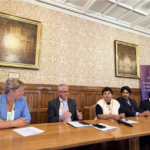


A petition with 1,251 signatures is calling for the scheme in Queen’s Park to be cancelled
Residents are calling for an end to a hyper-local traffic scheme in North West London that’s caused “deep and lasting division” in the community.
The bitter feud over the implementation of a controversial experimental low traffic scheme in Queen’s Park has been rumbling on for years. Initially dropped after plans were first proposed in 2020, tensions reignited in 2023 when Brent Council began trialling a series of hyper-local traffic schemes in the area.
Its implementation has led to a hostile division forming between those residents in favour of the scheme and those against – or rather those who are benefiting from reduced traffic on their roads and those who are consequently experiencing greater levels on theirs.
The initial Experimental Traffic Order (ETO), which restricted car access on roads at certain times, expired in April of this year. However, the council introduced a new order 24 hours later, which could last for a further 18 months, after reducing the original enforcement hours of between 7am and 10am.
Opponents to the scheme claim the measures have simply worsened traffic on the boundary roads, whilst supporters believe campaigners “consider the rights of drivers more important than the rights of residents”.
At a recent Cabinet meeting (November 17), Sanjay Nazarali presented a 1,251 signature petition, which followed a previous one signed by 1,400 people that had been submitted by a different petitioner last year. It calls on the council to cancel the latest iteration of the ETO, which restricts cars on roads between Kingswood Avenue and Salisbury Road from 7.30am to 9am.
Addressing the Cabinet, Mr Nazarali said: “These ETOs have created deep and lasting division in our community. They’ve created a two tier ward, in which the relief enjoyed by a few has created an exactly commensurate level of pain for everybody else.
“[They] are not just about traffic. They are also about community cohesion. And the fact that I’m here, with a similar petition, and similarly high numbers, as a year ago, shows one thing – this thorn in our side is not going away.”
Mr Nazarali said the petitioners “do not believe that [the council] has listened to this pain”, pointing to a council document claiming the initial 1,400 petitioners “welcomed the scheme” but disagreed with how it was implemented. A statement Mr Nazarali described as “factually untrue”.
When a formal complaint was submitted requesting that the document be amended, Mr Nazarali said he was “shocked to discover […] that the officer appointed to investigate the complaint about the report is the [same] officer who wrote the report”. He called this “unacceptable governance” and “falling foul of Brent’s published complaints policy” and escalated it to the Council Leader, Cllr Muhammed Butt.
Mr Nazarali also took aim at Queen’s Park ward councillors, claiming there was “deafening silence from all of them” when they were asked whether constituents had been fairly represented in the report. He called for the “divisive and unfair ETO” to be cancelled, adding: “It is destroying the community in which I live. We all hope that actions will now be taken to restore trust in the council and to help heal our community.”
Cabinet Member for Adult Social Care, Public Health and Leisure and Queen’s Park Councillor, Neil Nerva, responded to the petition at the meeting. He said the traffic orders are by definition “experimental” and hopes the council comes up with a future strategy for the scheme “well before 18 months is up”.
He added: “When we go big, it’s very difficult to actually resolve issues across an area, and when we go small, it’s sometimes considered too micro, and that people say that there is impact outside that area. […] I would also highlight the fact that the original ETOs directly came from residents coming to the authority. […] We have a duty to listen to residents, and the question is how we can actually juggle the expectations of residents in one area with the wider area.
“I’m very pleased to see the traffic counters out recently, which shows that Brent is actually trying to get as much information as it can before reaching a decision. And, of course, ETO hours do not have to be what they are currently, they can go up, they can also certainly go down. So, I look forward to recommendations from officers.”
In response, Mr Nazarali told the Local Democracy Reporting Service (LDRS): “The main question I have asked to all councillors, and I have escalated to the leader, is simply ‘do you believe constituents were accurately and fairly represented in the report?’ […] I still don’t think I’ve got an answer to that question.”
Brent Council Leader, Cllr Butt, said: “[I am] more than happy to allow residents to come in and to make sure that their voice is heard and also to take into account the concerns that you’ve raised as well. As [Cllr Nerva was] saying, things can go up, things can go down. Things can also be taken away.”
Supporters of the scheme want the measures implemented as a way of preventing rat-running through their streets during the early mornings; they believe that traffic should primarily be kept to the main roads rather than residential streets. They also pointed to feedback on the ETOs highlighting the “positive impact” of the measures, including bike users, children walking to school, and elderly residents.
Co-founder of the local Anti Rat-Run Group (ARRG), Marina Cantacuzino, claimed there has been “a concerted and at times malevolent” campaign against the ETO by people who “consider the rights of drivers more important than the rights of residents”. She suggests that Summerfield Avenue, which was the catalyst for the ETOs, “still takes most of the traffic most of the time”.
Marina told the LDRS: “The ETOs have offered us a reprieve from constant traffic, for just one and a half hours on a weekday morning, already reduced from three hours to appease those opposed to traffic restrictions. Many of those persuaded to sign the petition aren’t aware of the history of the ETOs and have been leafleted misleading and alarmist information. The petition itself was started by the vice-chair of a neighbouring resident’s association which is supposed to be neutral.”
Cabinet Member for Public Realm & Enforcement, Cllr Krupa Sheth, said: “There has been extensive engagement from the community, including around 575 emails and submissions. Feedback has been wide ranging, with strong views expressed on both sides. Officers will consider all feedback alongside monitoring data, traffic surveys, air quality results, and the impact of everything before making a recommendation.
“We will continue to review all feedback and data before making a balanced evidence-based recommendation. The council remains committed to working with residents such as yourself and local counsellors to ensure we get the best outcomes in Queen’s Park.”
Don’t miss out on the biggest stories from across the city: Sign up to MyLondon’s The 12 HERE for the 12 biggest stories each day.