






Pivotal Consideration
- What is Inhaler? For what purpose Inhaler is used?
- Features of Inhaler
- Different Inhaler Medications
- How does Inhaler Work?
- Does it show any side effects & Interaction?
- What is COPD? And ACO?
- Why Choose Corticosteroid and long-acting beta2-adrenergic agonist (LABA) for the treatment of asthma and Chronic Obstructive Pulmonary Disease (COPD) Symptom?
- Clinical Evidence
- Safety and Precautions patient should know?
- Best Online Pharmacy to Buy Inhaler?
- Conclusion
Inhaler Hacks for better Breathing
Absolutely! The inhaler is a cornerstone in the treatment of asthma, easing symptoms and preventing attacks by delivering medication directly to the lungs. If used correctly, they are incredibly effective at managing asthma. Normal Breathing in, or inhaling involves Contraction of diaphragm that leads to extent chest cavity air enters through the nostrils into lungs, here dust and dirt particles get trapped into nasal hair allowing purified air to get in, where as in asthmatic breathing, contraction of diaphragm occurs and chest cavity expands but airways get narrow due to inflammation, mucus, and bronchospasm and air struggles to get in. It is very important to manage such condition and it may can affect overall oxygen mechanism.
Before proceeding towards treatment let’s focus on Asthma, how does it cause? What precautions is to be taken?
Asthma is a chronic respiratory condition that may affects the airways, causing inflammation, constriction, and mucus production. Having asthma can be very difficult, but with the proper treatment, you can control your condition and breathe easily. One of the best ways you can control your asthma is by using an inhaler e.g., Metered-Dose Inhalers (MDIs), Dry Powder Inhalers (DPIs).
What is Inhaler? For what purpose inhaler is used?
Inhaler encompasses various products and services aimed to treat Treats asthmatic symptoms and chronic obstructive pulmonary disease (COPD). An inhaler for asthma is a device used to deliver treatment directly to the lungs. The inhaler is filled with different medications that play the role of relaxing the muscles around the air passages.
Types of Asthma Inhalers
There are two kinds of inhalers that people with asthma may use:
- Metered-Dose Inhalers (MDIs): These inhalers dispense a definite amount of medication with each puff.
- Dry Powder Inhalers (DPIs): These are devices which dispense a powdered drug, which the user then
| Forms of Inhaler | |
| Metered-dose Inhalers (MDIs) | Quickhale SF 250 HFA based Inhaler, Combitide 25 mcg/ 125 mcg inhaler. |
| Dry Powder Inhalers (DPIs) | Symbicort, Seretide, Ventolin Rotacaps. |
Combination Therapy
Combination inhaler made for people with asthma and some with COPD. It pairs a fast, long-acting bronchodilator with an inhaled steroid. Together they help open airways and lower inflammation. This makes breathing easier, reduces wheeze, and helps prevent flare-ups when used as a regular maintenance inhaler. Asthmatic patients have been revolutionized by the inhaler, which is a great way for the lungs to receive their necessary medication. They’re really useful when properly utilize.
Uses of Combination Inhaler
- Dual action: Combine steroids (reduces inflammation) + bronchodilators (relax airway muscles).
- Better symptom control.
- It is convenient with multiple benefits.
Advantages of Combination Inhalers
- Enhances Lung Functions
- Reduction of symptoms and exacerbations
- Improved quality of life
- Improved asthma control
- Reduced risk of attacks
- Easier management.
How to use Inhaler?
- Read the leaflet that comes with the inhaler.
- Shake the inhaler and remove the cap.
- Breathe out fully away from the device.
- Put the mouthpiece in your mouth and close your lips around it.
- Press the canister and breathe in slowly and deeply.
- Hold your breath for 5-10 seconds, then breathe out slowly.
- If a second puff is required, wait about 30 seconds and repeat.
- Rinse your mouth and spit if your doctor advises (this reduces thrush risk).
- Keep the device clean and store as instructed.
Does it show any side effects or Interaction?
Yes, it may show some side effects like, throat irritation or dryness, hoarseness of voice, cough, headache, tremors, nausea, oral fungal infection (thrush), increased heart rate, muscle cramps.
Interactions
- Beta-blockers (e.g., Propranolol): May reduce the effectiveness of Formoterol and cause breathing difficulties.
- Diuretics: May increase the risk of low potassium levels when used together.
- Other bronchodilators: May enhance cardiovascular side effects like palpitations or tremors.
- Antifungal or antiviral medications (e.g., Ketoconazole, Ritonavir): Can increase Budesonide levels, raising the risk of side effects.
- MAO inhibitors (e.g., Phenelzine): May increase cardiovascular effects when combined with Formoterol.
What is COPD? And ACO?
Chronic Obstructive Pulmonary Disease is the progressive lung disease causing chronic airflow limition, is caused due to smoking which is approx. 80-90% of cases, air pollution specifically due to particulate matter, chemicals, occupational exposures, due to genetical cause alpha-1 antitrypsin deficiency. According to pathophysiology inflammation, airway narrowing, mucus hypersecretion, lung tissue damage can also lead to COPD. The common symptoms of COPD are Chronic cough (with sputum), Wheezing, Shortness of breath (dyspnea) and Chest tightness. Diagnosis, Spirometry (FEV1/FVC<0.7 Post-bronchodilator) followed by the Bronchodilators (Short-acting SABA, Long-acting LABA, Anticholinergics LAMA) Pulmonary rehab, oxygen therapy, smoking cessation.
Asthma COPD Overlap is a condition which has both conditions asthma and COPD with persistent airflow condition. It is caused due to Smoking, pollution, underlying airway inflammation. It shows symptoms like wheezing, shortness of breath, variable symptoms. Diagnosis can be done on the basis of symptoms, lung function, and history. For the treatment of Asthma COPD Overlap (ACO) always preferred Combo therapy (ICS+LABA/LAMA).
Spirometry is a non-invasive lung function test, it measures volume exhaled in 1 sec FEV1, total volume exhaled FVC, it also measures ratio of airflow limitation FEV1/FVC, it also measures PEF, Peak expiratory flow. It is done to diagnose COPD, Asthma, and ACO condition, also to access lung function, severity and to monitor treatment response.
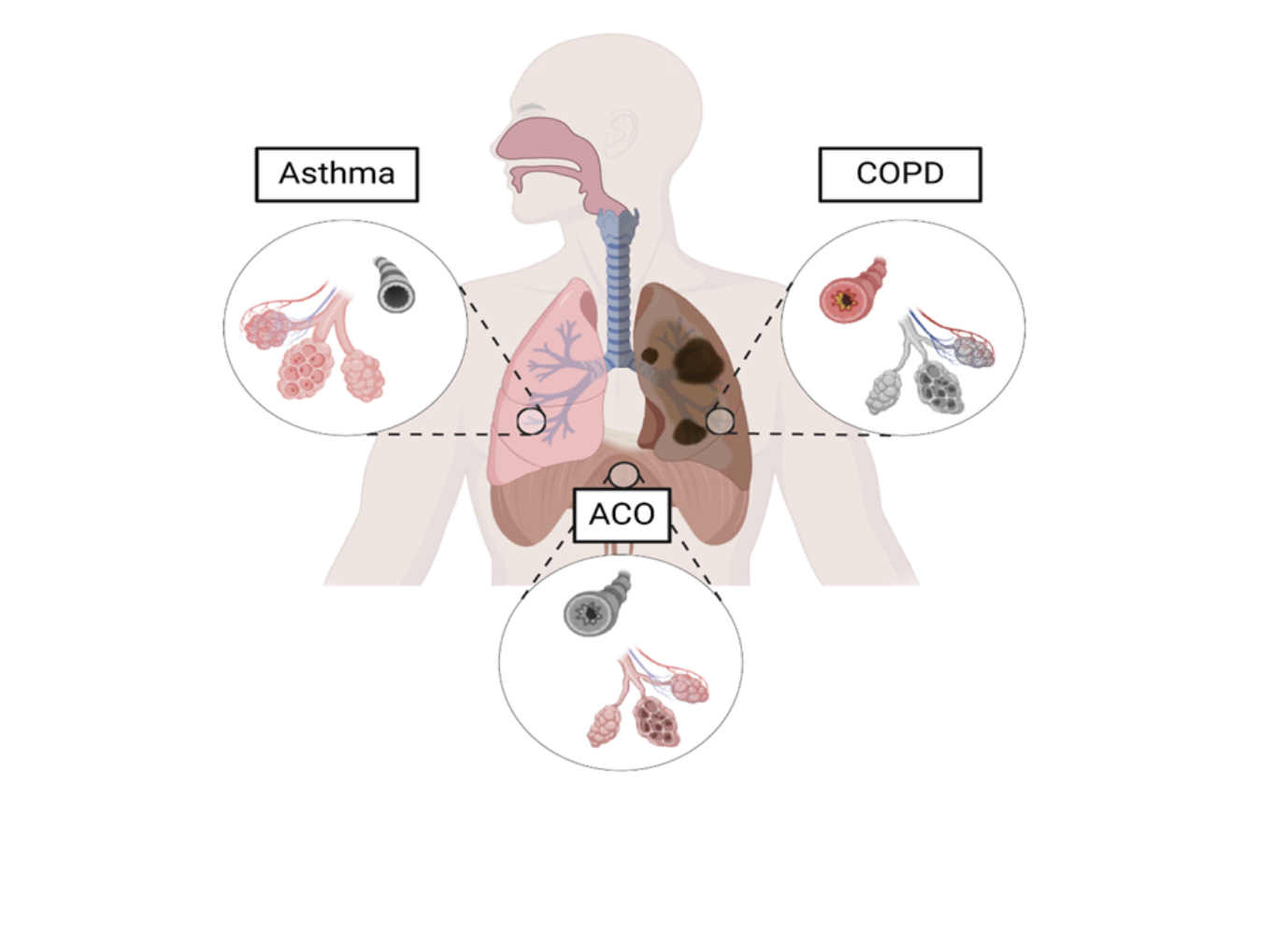
Normal breathing, FEV1/FVC>0. is considered to be good airflow where FVC and PEF is normal. In asthmatic breathing ratio of FEV1/FVC is reduced <0.7 where FVC is relatively preserved and PEF is reduced and is variable. In COPD breathing ratio of FEV1/FVC <0.7 persistent airflow limits where as FVC may be reduced and PEF is reduced. In ACO ratio of FEV1/FVC < 0.7 where FVC is reduced and PEF is reduced variably.
Why Choose Corticosteroid and long-acting beta2-adrenergic agonist (LABA) for the treatment of asthma and Chronic Obstructive Pulmonary Disease (COPD) Symptom?
A combination of corticosteroids, or ICS, and long-acting beta-2 agonists, or LABAs, represents an extremely effective therapeutic approach for managing patients with asthma and COPD. Where, ICS (Corticosteroids) are strong anti-inflammatory drugs that act on the basic airway inflammation, thereby reducing inflammation, mucus secretion, and airway. LABAs, these are bronchodilator drugs that cause relaxation of the smooth muscles of the airways, leading to dilation of the airway openings, hence improved lung function. These medications possess certain anti-inflammatory properties, which improves the effects and COPD symptoms. Synergistic benefits of using Corticosteroid and long lasting beta2-adrenergic agonist (LABA) it increased efficacy both ICS and LABAs used together help to improve lung function, control symptoms, and prevent exacerbations more effectively than when used separately. Control of Symptoms, LABAs offer quick and long-lasting bronchodilation and ICS helps to suppress inflammation in the airways. Reduced Exacerbations, combination therapy decreases the risk of asthma and COPD exacerbations, as well as the risk of death. Steroid-Sparing Effect use of LABAs enables a reduced dose of ICS, thus preventing side effects.
Clinical Evidence
Many trials have proven the effectiveness of ICS/LABA fixed-dose combinations in the case of asthma and COPD, including:
- Increased lung function (FEV1)
- Reduction of symptoms and quality of life
- Lower Exacerbation Rates
- Improved overall disease management
Many guidelines like GINA and GOLD advise the use of combination therapy of ICS and LABA as an alternate in the treatment of moderate to severe asthma and COPD patients.
- Patients Selection: ICS/LABA can be offered to those with moderate to severe disease, who are uncontrolled on monotherapy.
- ICS-associated risks: Be alert for potential side effects of the medication, like osteoporosis, cataracts, and pneumonia
- LABA safety: LABAs should be prescribed with care when patients have concomitant cardiovascular disease.
Precautions
- Avoid use if allergic to an active ingredient, or any components of the inhaler.
- Use cautiously if you have heart rhythm problems, hypertension, or coronary artery disease.
- Corticosteroids can suppress the immune system use with caution if you have active infections, such as tuberculosis or fungal infections.
May increase blood sugar levels monitor regularly if diabetic. - Use cautiously if you have hyperthyroidism.
Consult your doctor before use; only use if the benefits outweigh the risks.
Should be used under strict medical supervision in children under 12 years. - Always rinse your mouth after each use to prevent oral thrush (fungal infection).
Medical Advice for the Treatment of Asthma
- Pregnancy and breastfeeding: Use only if clearly needed and after discussion with your clinician.
- Older adults: May be more sensitive to side effects such as tremor, dizziness, or osteoporosis.
- Children and adolescents: Check approved age ranges on the pack; many combination inhalers are for ages 12 and up unless specifically licensed for younger children.
- Asthma treatment will require both meds and changes in lifestyle. Here’s the break-down.
- Inhalers: These are normally the first choice of treatment and is direct form of medication to the lungs.
- Controller meds: These are like steroids, decrease swelling, thus preventing symptoms.
- Reliever meds are quick-acting bronchodilators that help to improve FEV1/FVC ratio.
- Combination Inhalers: Combine different drugs for better control.
- Lifestyle Changes: Stay active, avoid smoking, follow healthy lifestyle.
Key Tips
- Utilize inhalers as directed.
- Symptoms monitoring and management of therapy.
- Triggers should be identified and avoided.
- Regular check-ups with your doc.
Conclusion
Combination Inhalers are the best for the Asthma treatment. Together they help open airways and lower inflammation. This makes breathing easier, reduces wheeze, and helps prevent flare-ups when used as a regular maintenance inhaler. Asthmatic patients have been revolutionized by the inhaler, which is a great way for the lungs to receive their necessary medication. In asthmatic breathing ratio of FEV1/FVC is reduced <0.7 improves with bronchodilator where FVC is relatively preserved and PEF is reduced and is variable. In COPD breathing ratio of FEV1/FVC <0.7 persistent airflow limits where as FVC may be reduced and PEF is reduced and doesn’t improve much with bronchodilator. In ACO ratio of FEV1/FVC < 0.7 some reversibility with bronchodilator where FVC is reduced and PEF is reduced variably.
They’re really useful when properly utilize. But it recommended to prior consult a medical professional or doctor.
Get the most out of your inhaler the best one for you at the Best Price from https://edpillsforever.com/ Your trusted Online Pharmacy.