





After 14 rounds of negotiations and nearly a year since its signing on 24 July 2025, the India-UK CETA is now operational. The agreement, which eliminates tariffs on 99% of Indian exports to the UK and reduces tariffs on 90% of UK exports to India, has been described by Commerce Minister Piyush Goyal as one of the most significant trade pacts for India in recent years.
But at the UK Parliament on 13 July 2026, the message from the UK India Leaders Conference was clear: the real work begins now.
A strategic preview report
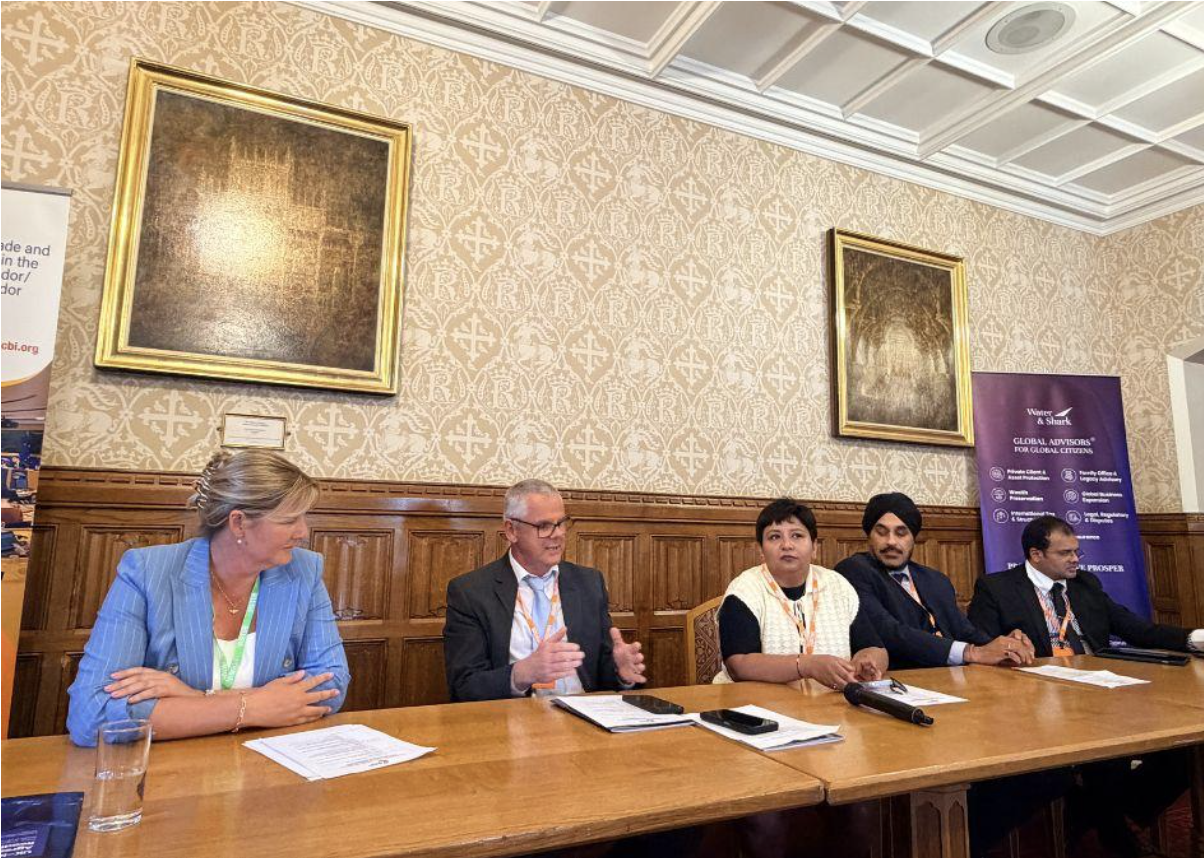
Ahead of the agreement’s entry into force, a strategic preview report titled “UK-India CETA: From Agreement to Business Readiness” was unveiled at the UK Parliament. The report, prepared by Water & Shark in association with the Europe India Centre for Business and Industry (EICBI), was presented during the 31st session of the UK Parliament convened on UK-India trade relations.
The preview release was attended by Members of the UK Parliament of Indian origin, including Sonia Kumar MP, Lord Rami Ranger and Lord Kuldip Sahota, alongside Baroness Pola Uddin and Navendu Mishra MP. From Water & Shark, the team included Advocate CA Harsh Patel, Founder & CEO; Sujit S. Nair, Chairman of EICBI and Managing Director & Senior Partner; and Dr David Bozward, Chair of Global Research Board.
Centred around the theme “From Agreement to Action: Unlocking the Opportunities of the UK–India Free Trade Agreement,” the discussion examined how the CETA could unlock opportunities across trade, investment, innovation, services, supply chains and professional mobility.
Government’s implementation push
The focus on implementation is not limited to the private sector. On 27 June 2026, Commerce Minister Piyush Goyal launched a practical business utilisation manual for the India-UK CETA in London. The manual, developed jointly by the UK India Business Council and HSBC India, provides a sector-wise roadmap by converting key provisions of the agreement into actionable insights for businesses.
Speaking at the launch, Goyal described the manual as a first-of-its-kind business utilisation guide that transforms a complex trade agreement into a practical roadmap for companies operating across both markets. He urged Indian businesses to deepen engagement with their UK counterparts to leverage the agreement’s opportunities.
Commerce Secretary Rajesh Agrawal, briefing the media ahead of the agreement’s entry into force, said the agreement is expected to create new opportunities for farmers, MSMEs, seafood exporters and labour-intensive sectors. He added that the government’s focus will now be on ensuring Indian exporters fully utilise the preferential market access available under the agreement.
First shipments flagged off
On the day the agreement entered into force, the first export consignments under the India-UK CETA were flagged off from multiple locations across India. In Ahmedabad, a maiden shipment valued at over 3.07 crore rupees (approximately £290,000) was dispatched, encompassing industrial equipment, pharmaceuticals, automobiles, polymers and textiles from seven key regional exporters.
Similar ceremonies were held in Chennai and Punjab, where ready-made garments and woollen yarn were flagged off for UK markets.
Political response
Prime Minister Narendra Modi said the CETA will give fresh momentum to India’s farmers, entrepreneurs and MSMEs, with several vibrant sectors gaining stronger access to the UK market. Defence Minister Rajnath Singh said the agreement will boost exports, create new opportunities for MSMEs, support Indian industries, and benefit professionals working in the UK.
Home Minister Amit Shah described the treaty as one that will extend significant exemptions to Indian professionals in the UK while strengthening ties between the two nations.
What’s next
With the agreement now in force, the focus shifts to monitoring its impact. Industry estimates suggest bilateral trade has the potential to nearly double to around USD 120 billion by 2030. But as one observer at the UK Parliament event noted, the success of the agreement will be measured not in the number of signatures on the document, but in the number of businesses that actually use it.
The message from Westminster is clear: the agreement is now in force. The window of opportunity is open. Whether businesses walk through it is now up to them.